Facebook
 Instagram
 Twitter
 Linkedin
Andrew Chim, chemistry teacher, Fellow & Diamond Member of the Gemmological
Association of Great Britain, explores natural and lab-grown diamonds
Valentine’s Day spending in the UK rose by 7.1% in 2025 year-on-year. However, even though we spent more, the stress of deciding what to purchase affected 52% of shoppers last year. Statistics from the Nation Retail Federation in the USA showed record spending on jewellery in 2025, breaking the record for 2024 and China’s demand in gold jewellery spiked ahead of last Valentine’s Day as shoppers veered away from other luxury gifts. This growing trend in gifting jewellery confirms one of my personal mantras: you can’t go wrong with jewellery.
Now that I’ve explained the market and I have told you jewellery is a safe option, the next question is: what kind of jewellery should you buy to represent your love? Thanks to decades of marketing by DeBeers, diamonds have become synonymous with love. Indeed, their superb hardness, durability and beauty mirror the quality we seek most – that of a love everlasting. In the last few years the diamond market has been turned upside down by the rapid emergence of so-called “lab-grown” diamonds, which have brought consumers a hugely lower price per carat than their natural counterparts.
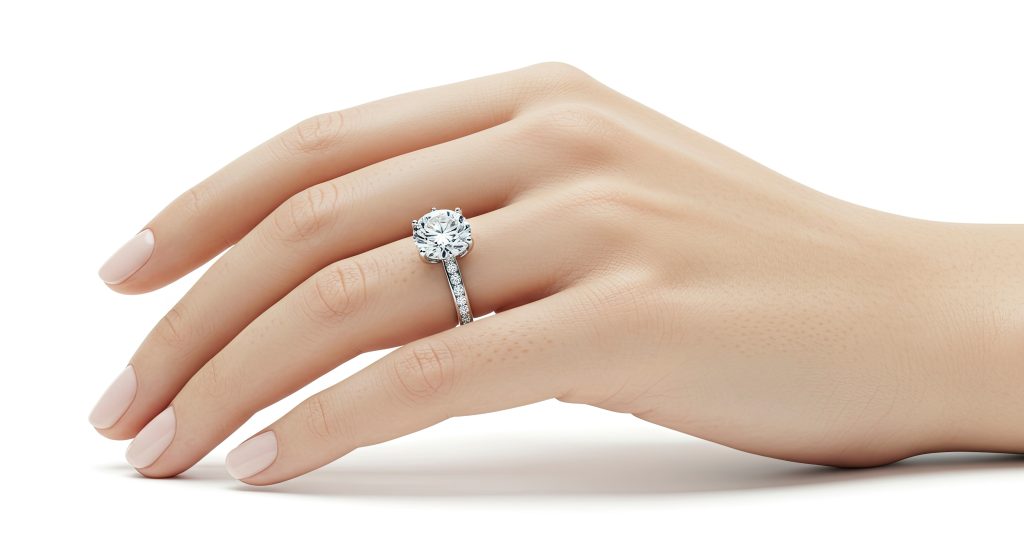
But, do you know what you’re buying? The descriptor “lab-grown” might conjure up images of scientists carefully hand-growing crystals in their labs. Many experts in the industry would prefer the more accurate description of “factory-made” given that they are made in huge factory buildings with row upon row of CVD or HPHT machines mostly in China (70%) and India, who are producing synthetic diamond by the tonne. I will be referring to these diamonds by their gemmological definition: synthetic i.e. an artificial gemstone with the same chemical composition as its natural analogue. So, are they real diamonds? Of course they are in terms of their chemistry and physics – they are actually purer than most of what Mother Nature can make, unlike diamond simulants such as cubic zirconia (zirconium oxide) or synthetic moissanite (silicon carbide) which imitate the look of diamond while not being pure crystallised carbon. This does not make them identical to natural diamonds, however. Gemmologists and testing labs have an array of screening and advanced techniques to differentiate between a synthetic and a natural diamond because of the presence of certain arrangements of nitrogen that are detectable in a spectrum and also the way they fluoresce and phosphoresce.
Often the ethics of diamond mining are brought up to draw consumers into opting for lab-grown diamonds. “Blood diamonds” – those who profits funded conflicts in Sierra Leone, Angola and the Democratic Republic of the Congo in the 1990 and early 2000s are still, rightly, in people’s memories. What many people do not know is that the Kimberley process – a global, UN-backed scheme set up in 2003 to eradicate conflict diamonds – has largely put a stop to conflict diamonds and accounts for 99.8% of global rough production. Far from being a blight on the developing world, mining has transformed economies. Botswana’s rise out of poverty is due to its natural diamond industry, which has produced the second biggest diamond ever recorded. The industry creates jobs and uplift communities in Namibia. Aboriginal communities are consulted, respected and supported economically by Dominion Diamonds in Canada’s Northern Territories.
If you’re looking for a more environmentally friendly option, synthetic diamonds do seem to be a greener choice with far less greenhouse gas emissions, water use and pollution by mercury and cyanide. However, the picture is still nuanced. Synthetic diamonds produced from the High Pressure High Temperature (HPHT) technique whereby graphite or diamond powder is subjected to temperatures and pressures mimicking the conditions in nature where diamonds are created in the Earth’s mantle, still require a source of graphite or diamond that is itself mined. Synthetic diamonds made by chemical vapour deposition (CVD) require a source of methane which mainly comes from a fossil fuel source (although, Dale Vince’s CVD diamond company Skydiamond sources their methane from captured carbon dioxide that is bacterially fermented). The energy for the process of synthesising lab-grown diamonds may come from a renewable source, such as solar panels or from burning coal, though it’s impossible to know which source of energy your average synthetic diamond in a shop window used, unless you go with Skydiamond, who claim to use 100% renewable energy.
I think the choice between synthetic and natural runs parallel to the choice mankind has had to make, and will continue to have to make, whether it’s AI-generated art, literature and film and work created by humans or the choice of fast fashion or slow, fast or slow food, live performance or the recording. What draws many gem-lovers to stones is that they are miracles of nature that have been worked by mankind through the centuries to reveal their beauty. They have been formed by happenstance where the correct elements just happened to come together under perfect geological conditions; their imperfections and inclusions reflecting the beautiful flaws in us as human beings. In the future I think we’ll live in a world with both synthetic and natural diamonds, just as fast food lives alongside haute gastronomy… But what will you choose?
Andrew has worked in education for 13 years. You can follow him @chimmologist on Instagram. Also visit gem-a.com
Share