Facebook
 Instagram
 Twitter
 Linkedin
Pictures by Craig Herron & Andrea Jones
Environmental expert and co-designer Dr Ed Barsley tells us about the Flood Resilient Garden at the Chelsea Flower Show & at Howbery Park
The Flood Resilient Garden, which was first on display at the Chelsea Flower Show, is now ready to inspire visitors in its forever home at Howbery Business Park in Crowmarsh.
Entrance is free of charge (weekdays only) with the aim of helping visitors find ideas on how to use garden design to help protect homes from flooding. It also showcases plants that can recover after flooding, helping gardens bounce back and saving homeowners money on replacing their greenery and blooms.
Given that one in four homes are at risk of flooding in the UK, these sorts of tips are definitely needed. In designing the Flood Resilient Garden, we have tried to show that outdoor spaces can be beautiful as well as having a function in controlling rainwater. The principles on show at Howbery, where the garden occupies a fairly large space, can be adapted to fit smaller, privately owned gardens.
A condition of entering the RHS Chelsea Flower Show is to plan a forever home for the garden. Flood Re, the sponsors of the Flood Resilient Garden, were keen to pick a permanent site in a region that is prone to flooding, so South Oxfordshire fitted that criteria. Howbery Park’s spacious grounds seemed ideal, especially as its owners, HR Wallingford, help develop resilient approaches to flooding.
I worked with garden designer, journalist and author Naomi Slade in planning the garden for the RHS Chelsea Flower Show. We considered its forever home from the off, for instance incorporating willows into the design, which can be found elsewhere in the Howbery grounds. They also like moist conditions.
However, the space in Oxfordshire is larger than that at Chelsea, and is flanked by the Manor Café and an office, so we needed to scale up the garden and tailor it to suit its permanent site and setting. To do this, I worked on landscaping and garden design with Belderbos Landscapes, which built the Chelsea and Howbery garden. The aim was to create a space for the local community and wildlife to enjoy for many years to come, as well a place for visitors to learn about making their own gardens flood resilient.
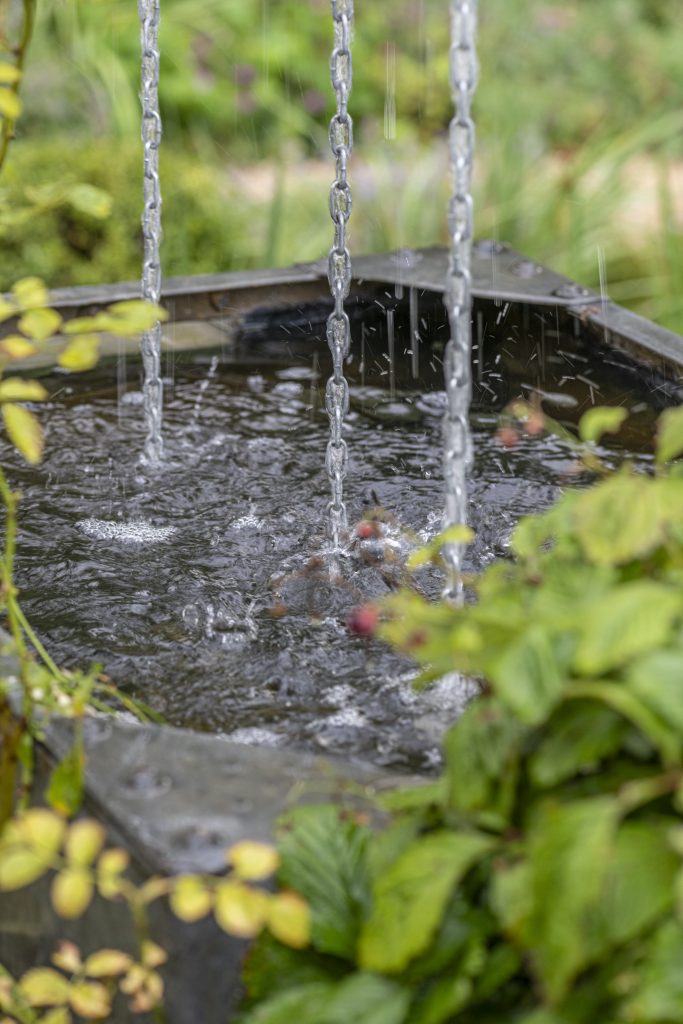
In order to help reduce flood risk, the garden slows and stores rainwater, using hard elements such as galvanised tanks and dense planting. The pergola has an integrated gutter that channels rainwater from the rooftops down and into the garden via rainchains and a series of large reclaimed galvanised tanks. These help slow the flow of rainwater rushing into the garden and store it for later use.
You can find out more about the garden and flood proofing for your own outdoor space at floodre.co.uk/flood-resilient-garden and at howberypark.com/flood-resilient-garden
Share