Britain in the 1930s: 900 photographs reveal a country on the cusp of change
More than 900 fascinating photographs capture Britain in the 1930s – a decade of contrasts, when traditional ways of life met a rapidly changing modern world. From Oxford's familiar streets and the villages of the Thames Valley to historic landmarks, seaside holidays and rural traditions, this remarkable archive offers a glimpse into life almost 100 years ago.
Britain in the 1930s was a country of contrasts. While economic depression and unemployment hit many communities hard, other parts of the country were enjoying growing prosperity, new suburbs and an increasingly modern way of life.
Now, more than 900 black-and-white photographs offer a fascinating glimpse into this changing world, capturing everything from busy town centres and traditional village life to seaside holidays, sporting events and historic landmarks.
Britain in the 1930s, by historian and conservationist Steven Brindle and writer and teacher Maureen Hill, brings together remarkable images from the Associated Newspapers archive, many of which have never been published before.
The photographs reveal a country caught between old and new. Horses and carts still shared the roads with motorcars, ancient market towns retained their traditional character, while cinemas, dance halls, lidos and new leisure activities reflected changing lifestyles.
The decade also saw a golden age of seaside holidays, with families flocking to resorts such as Brighton, Margate, Blackpool and Morecambe. Camping, walking and boating became increasingly popular, offering welcome escapes from the pressures of everyday life.
Familiar sights across the Thames Valley
The collection includes many photographs of Oxford, capturing familiar landmarks and everyday scenes. Views of St Aldate's show the entrance to Christ Church beneath Tom Tower, while shoppers can be seen browsing inside Blackwell's Bookshop on Broad Street.
Other images capture Oxford's High Street, from Magdalen Bridge to Carfax, with its colleges, shops and cafés.
There is also an early example of road-safety awareness from 1932, showing schoolchildren being escorted across a busy Oxford road by a man holding a 'Safety-First' sign.
Nearby, Windsor Castle features in a striking aerial photograph showing the State Apartments overlooking the Sunken Garden. In August 1936, admission to the State Apartments was reduced from one shilling to sixpence.
Eton College also appears, with photographs of the Headmaster's Room and Memorial Hall, where pupils can be seen wearing the school's traditional uniform of tailcoats, waistcoats and top hats.
Traditional towns and country customs
Across Buckinghamshire, the photographs capture the historic character of Amersham and its medieval market-town High Street. St Mary's Church dates from the 13th century, while the Market Hall was built in 1682.
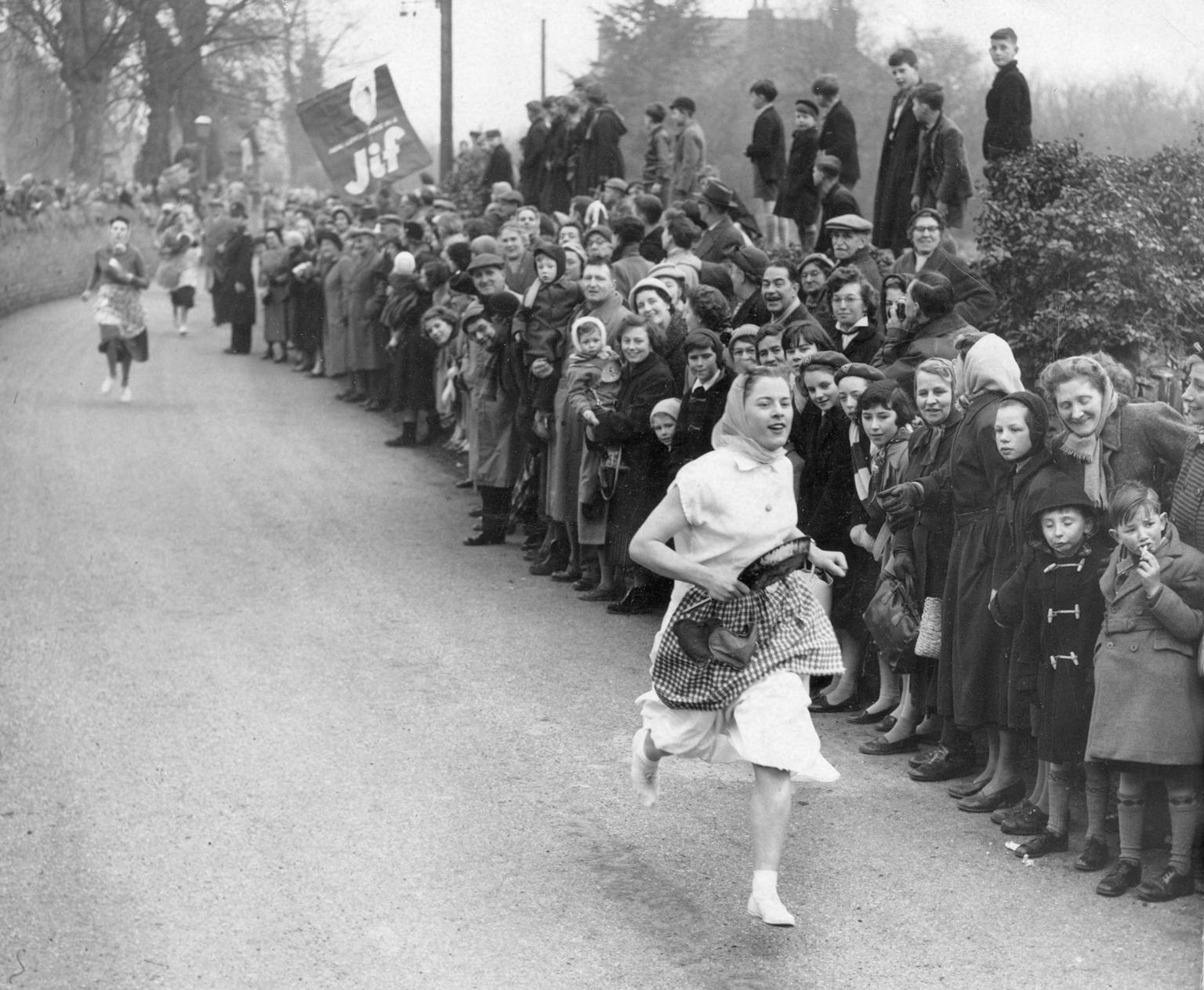
Olney provides another familiar sight with its famous Pancake Day race. Dating back to 1445, the tradition sees women run more than 400 yards from the marketplace to the church of St Peter and St Paul, tossing pancakes as they go.
The countryside also features prominently, with scenes of the South Oxfordshire Hounds riding through Horspath and traditional rural activities continuing much as they had for generations.
Along the river and into the countryside
The River Thames is a recurring feature, reflecting its importance to the area's social life. At Bourne End, cattle cool off beside the water as sailing dinghies approach the finishing line at the Upper Thames Sailing Club.
Henley Royal Regatta is also featured, with a collection of rowing photographs including celebrations of its centenary in 1939.
Further west, Wiltshire's historic villages and landmarks are brought to life. Picturesque Castle Combe appears with its medieval bridge and historic buildings, while Salisbury's busy livestock market is captured in 1935.
There are also photographs of Avebury's ancient stone circle, Malmesbury Abbey and the historic village of Lacock, which was then owned by Matilda Talbot, granddaughter of photography pioneer William Henry Fox Talbot.
Nearby Woodstock features the Bear Hotel, one of the area's oldest inns, dating back to the 13th century.
Everyday life, leisure and changing times
Surrey and Hampshire provide another fascinating snapshot of life in the 1930s.
In Guildford, crowds enjoy the open-air swimming pool in August 1936, while another photograph shows the High Street flooded after heavy rain and melting snow in February 1933.
Two contrasting images of Virginia Water capture bathers enjoying the lake in summer and skaters taking to its frozen surface in winter.
Transport was changing rapidly, too. Photographs show cyclists tackling Guildford's cobbled High Street, cars and buses sharing the roads in Egham, and a Ford Cabriolet passing through Midhurst in 1930. An aerial view of the South Downs also reveals how much of the landscape remained open and undeveloped.
Shopping and commercial life feature in busy street scenes from Croydon and Guildford, while a photograph from Alton in 1934 shows a resident collecting water from a standpipe in the market place.
The collection also captures moments of wider historical significance, including the 1935 General Election in Guildford and pupils at Bedales School in Petersfield. Founded in 1893, the school was among the pioneers of co-education, and a 1934 photograph shows boys and girls sitting together in class.
There is even a reminder of the approaching conflict, with the 3rd Dragoon Guards pictured resting in South Warnborough in August 1933.
A country on the brink of a new era
From seaside resorts and busy high streets to ancient villages and country traditions, these photographs reveal a Britain that was changing, but still deeply connected to its past.
As JB Priestley famously described, there were three Englands: the ancient country of cathedrals and villages, the industrial Britain created by the Victorians, and the emerging world of suburbs, cinemas and motorcars.
This remarkable collection captures all three, offering a window into everyday life during a decade that would soon be transformed by the Second World War.
Britain in the 1930s by Steven Brindle and Maureen Hill is published by Atlantic Publishing, priced £50.
Available from Amazon.
All photographs © Britain in the 1930s, Atlantic Publishing.