Headlines & Hedgerows

Round & About

Our countryside & its wildlife is at risk. We encourage you to join the campaign to save our endangered hedgerows and share an exclusive extract from John Craven’s new book.

The hedgerows that criss-cross our countryside are not only an iconic sight, but a vital habitat and corridor for many of our native species. However, they are becoming increasingly fragmented which is threatening the wildlife that depends on them.

We’ve lost about half our hedgerows since WWII. Although the rate of direct hedge removal has been reduced, hedgerows are being lost simply through how they are managed.

“With 70% of UK land being agricultural, hedgerows offer the safest route for wildlife to travel across farmland,” says Megan Gimber, key habitats project officer at PTES. “Sadly, many hedgerows are becoming ‘gappy’, which fragments this amazing network. And, without more sensitive management, many hedgerows are at risk of being lost altogether. This is problematic, especially when we’re seeing a fall in numbers of the animals that depend on them, such as hedgehogs, bats, hazel dormice and song thrush.”

In Britain, habitat fragmentation is thought to be a limiting factor for the distribution of some species and a threat to others’ survival. Corridors play a vital role preserving a number of species deemed ‘at risk’. Some 16 out of the 19 birds included in the Farmland Bird Index, used by government to assess the state of farmland wildlife, are associated with hedgerows.

Healthy hedgerows reduce soil erosion, flooding damage and air and water pollution. They provide forage for pollinating insects, predators to keep crop pests in check and shelter for livestock, reducing deaths from exposure and improving milk yields. Hedges help us fight climate change by storing carbon and reduce the damage from flooding.
To take part in the Great British Hedgerow Survey or find out more, visit hedgerowsurvey.ptes.org

Hedgerow. Credit Allen Paul Photography & Shutterstock.com
annie-spratt-cZFe4oIIPg8-unsplash
An extract from John Craven’s new book

Headlines and Hedgerows is published by Michael Joseph

We have all heard that well-known piece of advice first coined by W.C. Fields: “Never work with animals or children.” Well, I’ve done both throughout my career (in fact, I couldn’t have succeeded without them!) so in my case at least that old adage is totally wrong.

I suppose one reason for my longevity is that I have never been very ambitious. I have not sought the headlines, never seriously courted celebrity nor been tempted to take chances on high-profile but potentially risky and short-lived programmes – apart from one, and that was Newsround, which was a six-week experiment in 1972. Thankfully it is still going strong so, as it turned out, it was not much of a gamble and a recent poll in Radio Times placed Newsround at number three in a list of the top 20 children’s programmes of all time.

And Countryfile is often in the top 20 of most-watched shows. During my 30 years there I’ve seen rural issues ranging from social isolation and deprivation to the way our food is produced climb higher and higher up the national agenda. That our audience is split pretty evenly between country dwellers and townies proves to me that, united as a nation in this at least, we want to preserve, protect and enjoy our glorious countryside…

For my Countryfile interview with Prime Minister David Cameron, we met for an hour at Cogges Manor Farm, a rural heritage centre in his Oxfordshire constituency. The cameras were set up around the kitchen table and before he arrived a lady who seemed to be in charge of his “image” wanted to know where he’d sit. She checked the angles and saw a large Welsh dresser in the background. “Could we move some of those plates and ornaments,” she said. “It’s too fussy.” It proved that politicians have learned to be careful what’s behind them on screen. An exit sign, for instance, would be the last thing they wanted.

When Mr Cameron came in, dressed casually in a jumper – this, after all, was Countryfile – he said “I was brought up on you, John!” I don’t feel particularly old but it’s alarming when the man leading the country says you were part of his childhood! We had a wide-ranging conversation and he had no idea of the questions beforehand. I challenged him on his plan to make his administration the greenest government ever (which didn’t really happen) and overdevelopment threats to the landscape. “I care deeply about our countryside and environment,” he told me earnestly. “I’d no more put them at risk than I would my own family.”

Today, I wonder what he’d make of the report by the Campaign to Protect Rural England revealing 15,500 new houses have been approved in areas of outstanding natural beauty in the years since. We also talked of his plans for a free vote in Parliament on bringing back hunting with hounds (which never happened) and persuading all other EU countries to enforce farm animal welfare laws as diligently as the UK (still waiting for that). I was impressed by his detailed knowledge of rural issues, even when pressed for details. A few months later at a Downing Street lunch for people involved in all aspects of the countryside, he smiled and said he hadn’t expected to be grilled by “a rural Jeremy Paxman.”

The Great British Hedgerow Survey

To take part in the Great British Hedgerow Survey or find out more

Think pink!

Round & About

It’s Breast Cancer Awareness Month – support the cause by buying these items & wearing pink on Friday, 18th October

1. Tickled Pink Ben & Jerry’s Love Is Topped, £2.50.

2. Dove Pomegranate, £2.85.

3. PG Tips, £2.

4. ghd gold ink on pink styler, £139.

5. Simple wipes, £3.

6. Pot noodle.

7. Vaseline Rosy Lip Tin, £1.50.

8. Lulu Guinness Breast Cancer Now Natasha in chalk blush, £145 .

9. ELEMIS Breast Cancer Care limited-edition Pro-collagen Marine Cream, 100ml.

Find out more

Please visit website to join the campaign!

Beeline to bliss

Round & About

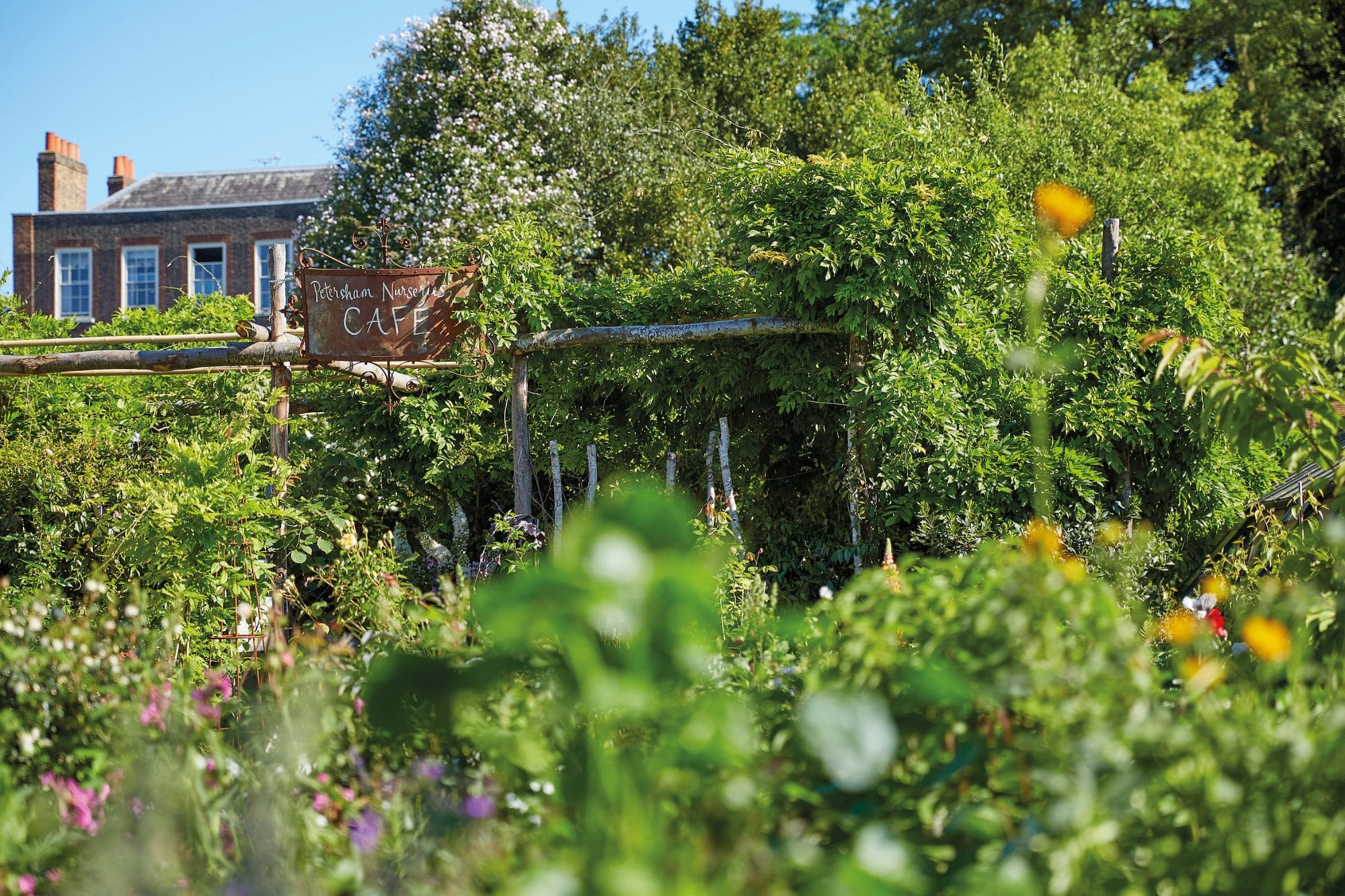
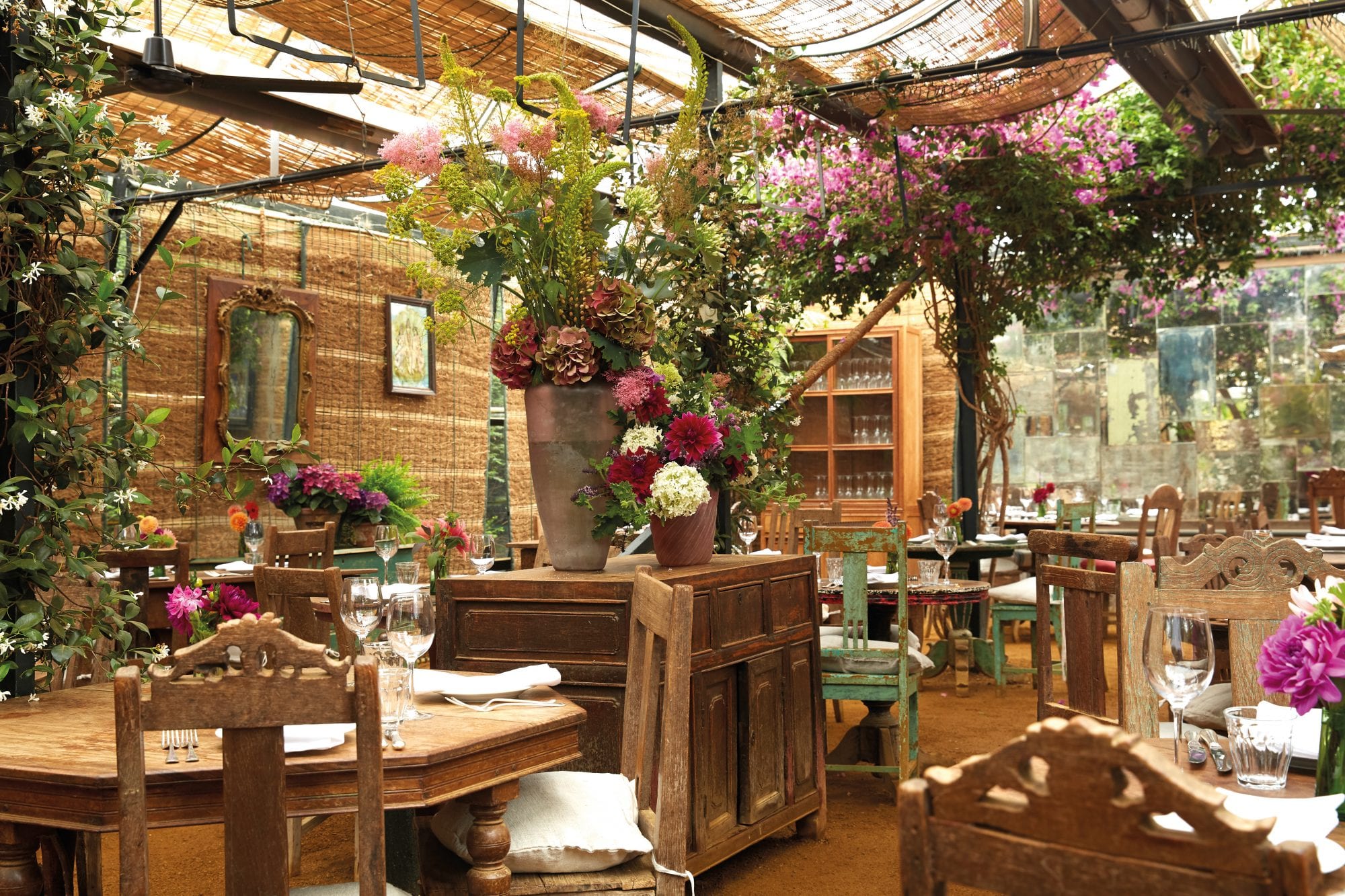
Petersham Nurseries – Richmond’s visionary garden center and lifestyle mecca – is one of West London’s greatest treasures and creative success stories.

The family behind the business are celebrating their 15th birthday, looking back on their humble beginnings as a dilapidated local plant shop, and how much has changed. Now with a second branch in Covent Garden, the small empire includes a homeware shop, florist, café, two restaurants and a wine cellar, with visitors come from near and far to discover Richmond’s unique lifestyle destination.

For September, they’re celebrating their birthday by paying homage to the gardener’s best friend, the honeybee, with a one-off masterclass in all things bee-related. In keeping with Petersham’s ethos, this will include a tasting session with Bermondsey Street Bees’ honey sommelier, a gardening session in planting bee-friendly flowers, a delicious lunch, and a ‘preserving with honey’ cookery class with Rachel de Thample.

Petersham's 15th Birthday

To sign up for this, on Thursday, 26th September

Vino veritas

Round & About

Jessica Elphinstone learns a thing or two about wine at Vagabond,  Fulham’s most underrated date spot

If you detest wine snobbery, and the whole glass-swirling, Merlot-gargling pomp of it all, then I’m totally with you. I spent my entire three years of university drinking £4.99 Gallo rosé, and that sweet, sickly nectar has a special place in my heart. But the wonderful thing about Vagabond is that, despite being a bouji wine bar and boasting over a hundred carefully selected bottles from indie vineyards across the globe, it is somehow also unpretentious.

First of all, the way you order the booze appeals to my inner vending-machine-loving child: Pre-load money onto a credit card, swipe into the recently revamped wine fridges, before clicking on the bottle you’d like and watching with glee as your chosen amount of wine comes pouring out. Taster sizes of 25ml are mostly around a couple of pounds, allowing people to sample a whole range of different wines you wouldn’t normally risk getting a glass of. We taste a tangy Spanish Albarino, a buttery, Meursault-style Reserva Branco from a sustainable smallholding in Alentejano (yes – I stole that from the tasting notes), and a questionable Italian Pecorino from Abruzzo.

Each wine comes with an information slip, onto which you can jot notes like ‘beeswax and tangerine’ or ‘pomegranate and watermelon’ if you so wish. My friend Chloe is a picky soul, and finds GM Henry’s pick, a Condrieu from the Northern Rhône which is one of the most expensive wines, not to her taste. We play games, bringing each other wines with tasting notes of honey, straw and water chestnuts, and try unsuccessfully to guess them. Around us, we see couples (a lot of first dates, apparently) doing the same, laughing and chatting as they pair their Tempranillo with delicious cured meats, artisan cheeses and charred Padron peppers.

Finally, we strike gold, and both fall in love with an Australian Zibibbo from winemaker Brash Higgins. “English Pears and Freesia” writes Chloe dramatically, now slightly less than sober. I imagine that this balance of light-heartedness, mixed with some actual exploration into new realms of wine, is exactly what Vagabond’s founder Stephen Finch imagined when he opened to doors to his first Fulham wine shop in 2010.

Screen Shot 2019-09-02 at 18.12.40
Fulham-1-1

Vagabond

Visit Vagabond Fulham, 18-22 Vanston Place, SW6 1AX
Contact on 0207 381 1717 or visit

Talking point: Country smile

Round & About

Liz Nicholls asks broadcaster & dad John Craven, 79, about his life & career ahead of his appearance at Guildford Literary Festival

We’re looking forward to reading your memoirs. How has it been looking back on your long & successful career? “It’s the first time I’ve written anything like this and it took a bit of getting used to. All through my TV career I’ve had to keep my scripts short – but the book gave me the chance to expand and I ended up with 93,000 words. There are chapters on everything from my childhood to Countryfile, taking in my time on Newsround and SwapShop – three programmes which were all TV ‘firsts’ and which I’m incredibly proud of. Some people would prefer to forget the shows that made them well-known. Not me!”

 How did you get into broadcasting? “I had a false start; at 18 I’d been ‘spotted’ by an ITV youth programme but they sacked me after a few appearances for being too old! So I went into print journalism, joined the BBC in Newcastle as a news scriptwriter in 1965 and made a few films for the regional Look Northprogramme. I then moved to Bristol as a freelance reporter. The network production centre there made children’s programmes, such as Animal Magicwith Johnny Morris and Vision On with Tony Hart, and I auditioned for the presenter role on a new one called Search. I got the job and that led to Newsround in 1972.”

What do you think has been your greatest highlight? “There’ve been lots but one that I recall in the book is when I knocked on a door and it was answered by a future saint…. Mother Teresa. I went to the Mother House of her nuns in the slums of Kolkata to make film about her mission to care for both the dying and young orphans and she was wonderful.”

If you could make one change to benefit the UK countryside, what would it be? “We need to stop young people leaving the rural communities by building more affordable homes and more amenities. Rural people have become increasingly isolated and we need to reverse that trend. More than a third of small farms have disappeared this century and many others are struggling to survive. Unless we can attract more people to farming I worry for the future of food production in this country.”

Where are your favourite parts of the UK? “My favourite spot in Oxfordshire is Blenheim Palace with its spectacular grounds and walks. I was born and bred in Yorkshire and have lived in the North East, Gloucestershire, Buckinghamshire and Oxfordshire – all places with wonderful countryside – but if I were to name my favourite part of rural Britain, it would have to be the Yorkshire Dales where, as a child, I first came face-to-face with nature.”

 Like me you started as a newspaper reporter – how do you feel about how the media industry has changed? “It’s so different now from when I set out. Television was black-and-white with just two channels. There wasn’t a clear career path and no such word as ‘media’. Now there are media degree courses galore, and many different programme outlets. On the minus side, there is a lot more competition. But I’m a great believer in luck, and with determination and a bit of talent, there is no reason why you can’t make it.”

Do you consider yourself healthy? “I don’t do anything special but I do try and make careful choices and be sensible. I also walk a lot, but that’s it. Until a few years ago I went to the gym regularly but I don’t feel the need to do that anymore.”

What advice would you give to any budding journalists or presenters? “I always say ‘Keep it short, keep it simple, keep it safe’.”

 Who would you most like to have worked with? “Thomas Telford is one of my heroes as he has had such an impact on our landscapes building canals, roads, bridges and viaducts. What a privilege it would have been to work with him.”

What’s on your horizon? “I’ve always dreamt of being on a big-budget programme but it’s never happened, and I know it won’t come along now. I’ve had a reasonable life from TV and continue to do so although it’s on my terms these days. I still do around 10 assignments a year for Countryfile, and I’m able to pick and choose.”

What are you reading now? “Airhead by Emily Maitlis. It’s a brilliant, often funny, behind-the-scenes account of her working life, written by one of Britain’s best television broadcasters. It proves she’s far from an airhead!”

What is your proudest moment? “Apart from becoming a father twice, it was receiving the OBE for services to children’s and rural broadcasting – the two areas that have defined my career.”

Headlines & Hedgerows:

John will talk about his memoir, Headlines & Hedgerows, at Guildford Book Festival on Tuesday, 8th October, 6.30-7.30pm, The Electric Theatre, Guildford. Book at via website or call 01483 444334.

October’s recipes: Italian job

Round & About

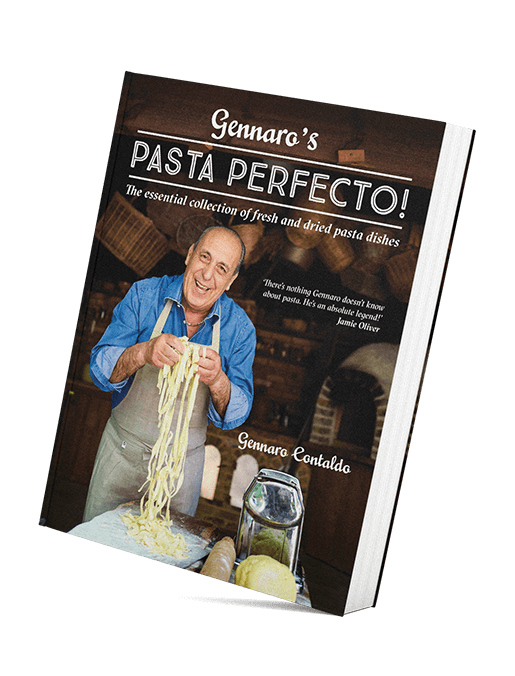
Chef & restaurateur Gennaro Contaldo shares two delicious autumnal recipes from his new book Pasta Perfecto

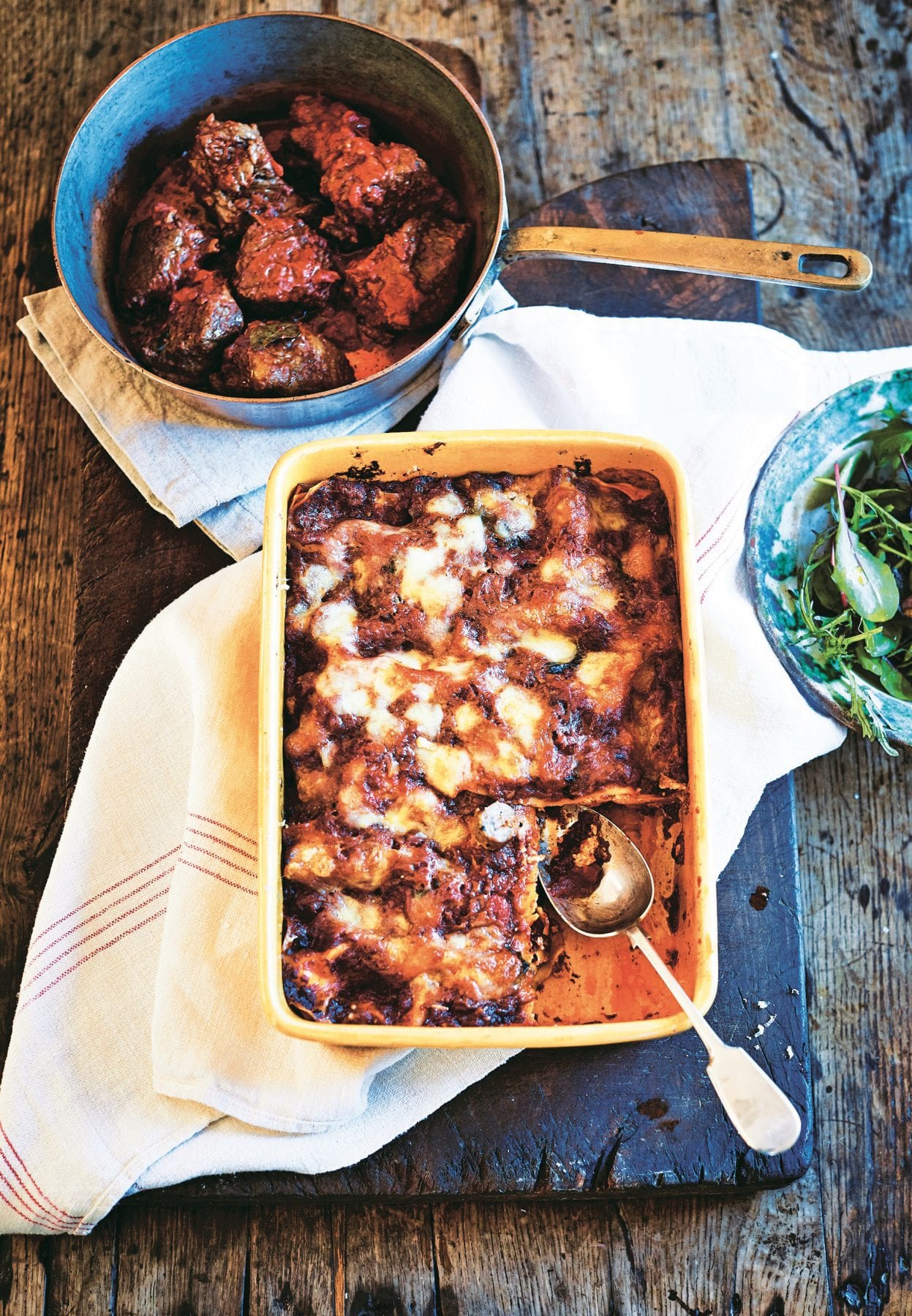
LASAGNE DI CARNEVALE

Carnival-Time Lasagne

(Prep: 30 mins – Cooking: Three hours (including cooking meat ragu) – Serves: 6)

Ingredients:

• 250g / 9oz Italian pork sausage
• Splash of extra virgin olive oil
• 350g / 12oz ricotta
• Two eggs
• 150g / 5½oz / 2¼ cups grated Parmesan
• Sea salt and freshly ground black pepper
• 12 lasagne sheets
• 250g / 9oz mozzarella, coarsely chopped

For the ragù:

• 3 tbsp extra-virgin olive oil
• One onion, finely chopped
• Two bay leaves
• 750g / 1lb 10oz beef brisket, cut into large chunks
• 5 tbsp red wine
• 1 tbsp tomato purée (paste) dissolved in a little warm water
• Three x 400g / 14oz cans of chopped plum tomatoes
• A handful of basil leaves
• 20g / ¾oz / ¼ cup grated Parmesan
• Sea salt and freshly ground black pepper


This typical southern Italian lasagne is usually made for special occasions such as Carnevale – the week before Lent when festivities all over Italy take place. Lent is traditionally a time when eating meat is forbidden, so a lasagne such as this one – with meat ragù and sausage – would be made to enjoy before the period of abstinence. Only the tomato sauce from the meat ragù is used for the lasagne; the beef can then be enjoyed as a second course with a green salad.

Method:

First make the ragù: heat the olive oil in a large saucepan over a medium heat, add the onion and bay leaves, and sweat for about 3 minutes, until softened. Add the beef and seal well all over. Increase the heat, add the wine and allow to evaporate. Stir in the tomato purée mixture, chopped tomatoes, basil, Parmesan and some salt and pepper, bring to the boil, then reduce the heat, cover and simmer gently for at least 2 hours, until the meat is cooked through and the sauce is thick. Check from time to time, stirring with a wooden spoon and, if necessary, add a little hot water.

When cooked, remove the beef and set aside to enjoy later.

Meanwhile, preheat the oven to 180°C fan/200°C/400°F/gas mark 6.

Cook the pork sausage: you can either do this in the oven or fry it. If using the oven, put the sausage into a roasting pan with a splash of olive oil and bake for 25 minutes. If frying, fry for about 15 minutes in a frying pan (skillet) with a splash of olive oil over a medium heat. When cooked through, remove, slice and set aside.

In a large bowl, combine the ricotta, eggs, half of the Parmesan, and some salt and pepper, until creamy.

Line the bottom of a baking dish (about 24 x 17 cm/9½ x 7 in) with some of the tomato ragù, cover with a layer of lasagne sheets, then add a layer of ricotta, scatter over some sausage slices and some pieces of mozzarella, then add another layer of tomato ragù. Continue making layers in this way until you have used up all the ingredients, ending with a layer of lasagne sheets, tomato ragù, mozzarella and the remaining grated Parmesan sprinkled on top.

Cover with foil and bake in the hot oven for 20 minutes. Remove the foil and bake for a further 20 minutes, until golden and bubbling.

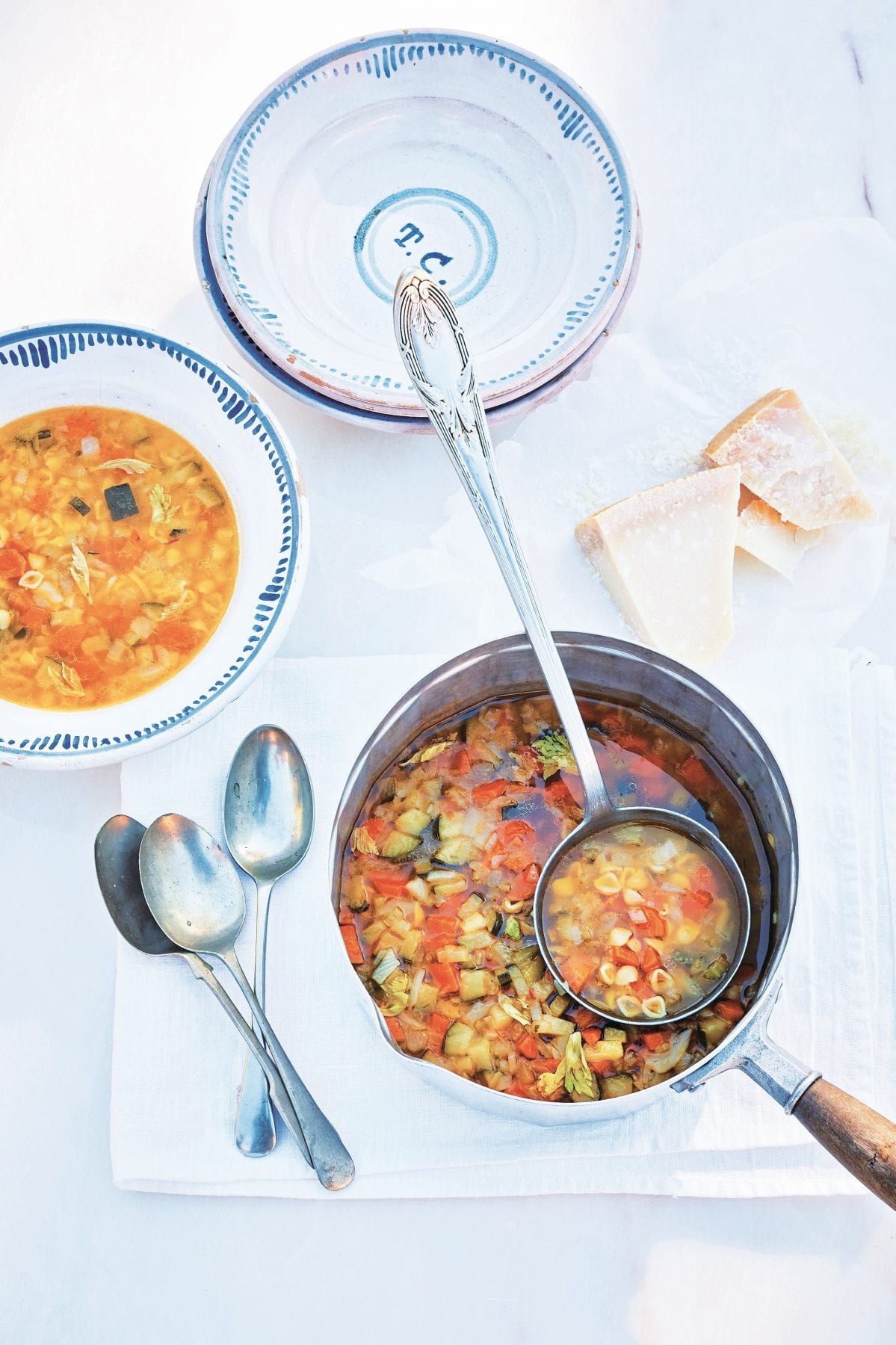
ZUPPA DI VERDURE E PASTINA

Vegetable and Pastina Soup

(Prep: 5 mins – Cooking: 15 mins – Serves: 4)

Ingredients:

• 3 tbsp extra-virgin olive oil
• ½ onion, finely chopped
• ½ celery stalk, finely chopped
• One carrot, finely chopped
• 85g / 3oz courgette (zucchini), finely chopped
• 800ml / 28fl oz / 3½ cups hot vegetable stock (bouillon)
• 85g / 3oz pastina (small pasta shapes)
• Grated Parmesan, to serve (optional)

This should be really be called ‘Olivia’s Soup’ as it’s my daughter Olivia’s favourite meal! Small pasta shapes (pastina) can be little stars, butterflies, alphabet shapes or even broken-up capelli d’angelo (very fine spaghetti) if you have nothing else. In Italy, there is a huge variety of pastina shapes to choose from and we always bring some back after a trip. For an even richer flavour, pastina can be made with homemade broths in place of the ready-made vegetable stock.

Method:

Heat the olive oil in a medium saucepan over a medium heat, add the onion, celery, carrot and courgette, and sweat for 2–3 minutes until softened. Pour in the vegetable stock, bring to the boil, then reduce the heat and gently simmer for 5 minutes. Add the pastina and cook until al dente (check the instructions on your packet for cooking time).

Divide between serving bowls and serve immediately with a sprinkling of grated Parmesan, if desired.

Raising spirits!

Round & About

Fancy a drink? And a sing-along? Join Putney’s Pub Choir, brainchild of local pianist, vocalist and music tutor Carl Speck

A trip to your local pub, a glass of your favourite tipple and a chance to sing your heart out… what could be better? The Pub Choir is a great way to socialise with friends, enjoy a drink and learn to sing new and familiar songs in the friendly and relaxed atmosphere of a pub.

“The Pub Choir is all about having fun,” Carl tells us. “Anyone can come along, from the most experienced singers to those who usually only sing their hearts out in the shower! We always work on songs that everybody knows – that way, the choir is easily split into two and we enjoy learning some simple harmonies for extra effect.

“This is a great way for new singers to have a go at singing in a choir. There is no commitment to come every week which is a real draw for many people. The added bonus is a glass of wine or a pint of beer (or two!) throughout the evening.”

The choir gather at The Duke’s Head in Lower Richmond Road, SW15 1JN, on alternate Tuesdays of every month, 8 -9.30pm, as well as other pubs. All you have to do is turn up, buy a drink and then sing. Each session costs £5. Lyric sheets are provided and Carl will teach three or four songs throughout the evening. With his expert direction, you will also learn the basics of good singing technique, as well as have the chance to sing in two or three-part harmony.

Carl adds: “Towards the end of the evening, a live recording is taken to share with your friends, family and the rest of the world! There is absolutely no need to have any previous singing experience or know how to read music. If you have some musical ability, you can view music for each session on the member’s page a few days before each session – your musical skills will be most welcome to support the rest of the group.

Contact Carl to access the Members’ Page and, if possible, let Carl know you are going in advance, just because this will help him with organising music for everyone. Upcoming datesfor planned gatherings are 15th and 29th October, 12th and 26th November and 10th December.

Find out more

Guildford town race

Round & About

Guildford’s first closed-road running race starting from the town’s cobbled high street takes place on 13th October. 

More than 1,000 runners are expected to take part, choosing to run either 5k or 10k in support of the charity partner Harrison’s Fund. 

The charity is named after Harrison Smith who suffers from Duchenne Muscular Dystrophy, a rare genetic condition which causes the muscles to waste away. One in 3,500 boys is born with the condition, the average lifespan is just 20 years of age and sadly, it is fatal. 

Dad Alex said they were excited to be the title charity partner for this first race in Guildford. He added: “It is such an iconic place with wonderful vistas that anyone who is a keen runner should take part. 

“By choosing our charity to run for you really can make a direct impact on a young person’s life.” 

Runners of all levels are invited to take part in the chip-timed races which are on flat routes from the cobbles towards Clandon and back. 

There’ll be plenty of points for spectators to stand and cheer runners on as well as live bands along the way to encourage competitors, all of whom will receive bespoke medals at the finish line. 

To take part in the run visit https://harrisonsfund.com/events.php/Runs-Walks-1/ 

If you prefer your entertainment to be more stylish then how about going to the Sky High Ball on 18th October. Now in its seventh year, the ball is the highlight of Harrison’s Fund’s year. After champagne on arrival, you’ll enjoy dinner with wine, table games, a goody bag for the ladies and the opportunity to bid in the silent and live auctions. 

More info

To find out more about this great event and to book a table…

A-Wey day at Wharf

Round & About

Illuminated boat pageant at dusk is the highlight of a day beside the river

Fingers crossed the sun shines again as boaters and visitors alike are welcomed to celebrate everything that is great about the river at the Wey River Festival.

There’ll be plenty to do, such as willow weaving, archery, a. pirate boot camp, Surrey Wood Turners and plenty of crafts and children’s activities.

Foodies will want to make a bee line for the stalls, with local jam and honey as well as things to tuck into as you wander round.
The highlight of the day is the illuminated pageant at dusk, with boats travelling from the centre of Guildford to Dapdune Wharf, brilliantly lit up. And while you wait for their arrival at Dapdune, experience the night sky with Guildford Astronomical Society through their magnificent telescopes while being serenaded by Croydon steel orchestra.

All this takes place on the tranquil waterway which runs for nearly 20 miles through Surrey. The Wey was one of the first British rivers to made navigable and opened t barge traffic in 1653.

The award-winning visitor centre at the Dapdune Wharf tells the story of the navigations and the people who lived and worked on them.

This is a ‘no parking’ regime at Dapdune Wharf this year, so please use town centre car parks. There will be a drop off facility for those unable to walk very far.

The event is free and starts at 11am on Saturday, 21st September.

If you can’t go along on the day, the Wharf is well worth a visit at other times with boat trips and trails to be enjoyed.

More info

The event is free and starts at 11am on Saturday, 21st September.

Coleshill Underground

Round & About

Pic credit: National Trust

Secret Second World War history revealed at Coleshill Underground 

The National trust village of Coleshill is celebrating its secret Second World War history with a living history event honouring the Auxiliaries. 

Coleshill Underground is returning to West Oxfordshire on Sunday, 22nd September with re-enactments, exhibitions, a display of military vehicles, food, drink and dancing as well as children’s activities. 

Unknown to villagers, Coleshill was the top secret training headquarters for the British Resistance, also known as the Auxiliary Unit in which brave men volunteered to act as a secret resistance force against invasion by Germany. They were trained in units of six in isolation from other groups and in unusual methods. 

The living history area will tell the story of the brave auxiliaries through re-enactors, exhibitions and interactive displays. The Second World War historic sites around Coleshill will be open to explore including the operational bases and guard house. 

Trace your own historical connections with the help of the Coleshill Auxiliary research team while younger members of the family have a go at an activity trail around the village learn about code breaking, the skills needed to be a spy and have a go at crawling under camouflage nets. 

Coleshill Underground is celebrating the 75th anniversary of the Auxiliaries being stood down from service. 

Tickets can be booked in advance via the website. 

Find out more

For more information and to book visit